
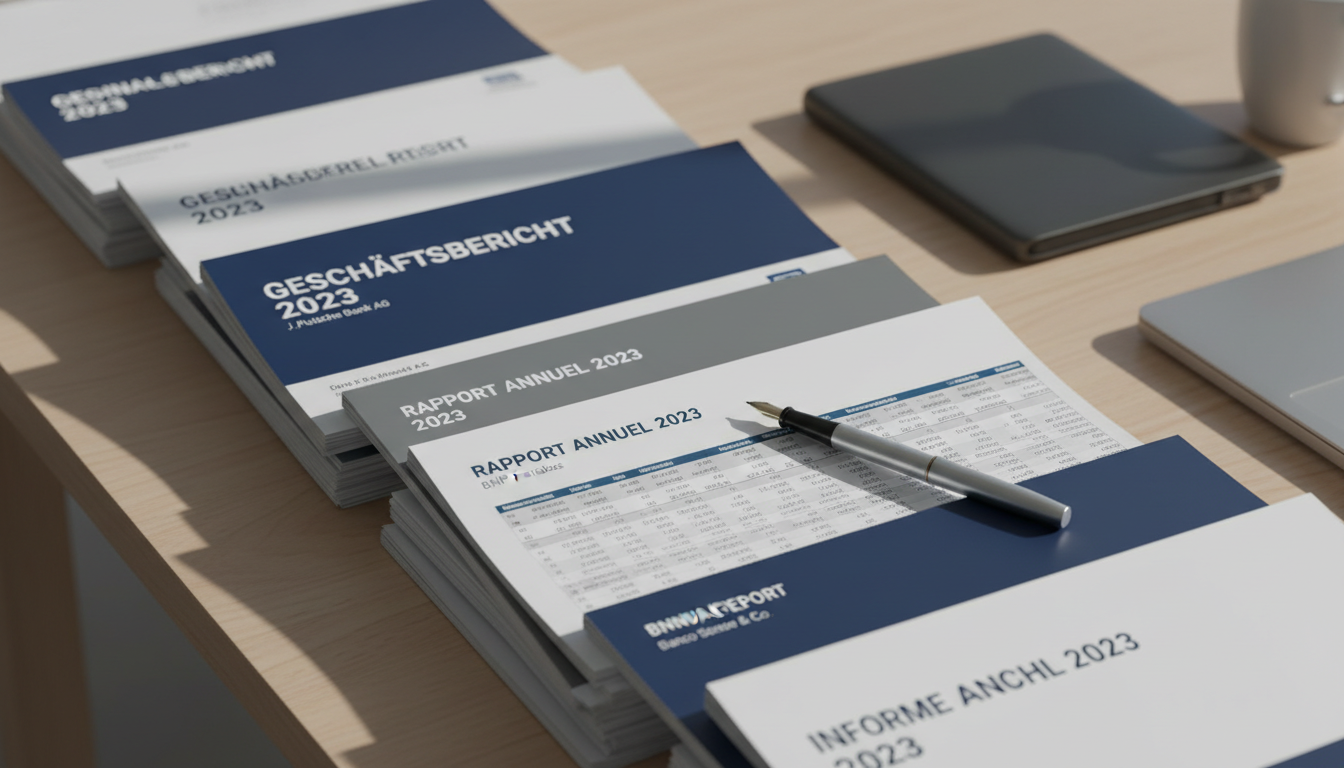
IFRS 18 requires companies to disclose non-GAAP metrics within audited financial statements, making IFRS 18 Management-Defined Performance Measures multilingual consistency essential for global regulatory compliance. Standardizing these translations prevents investor confusion and mitigates reporting risks by ensuring that unique financial narratives remain accurate across all target markets.
The transition from IAS 1 to IFRS 18 introduces a rigorous new framework for reporting non-GAAP figures, now formalised as Management-Defined Performance Measures. For multinational finance teams, the primary challenge lies in ensuring these subjective metrics retain their precise meaning across every jurisdiction and language. Even a slight linguistic drift between English, German, French, or Spanish disclosures can trigger regulatory scrutiny or erode investor trust. This article explores the strategic importance of multilingual consistency under the new standard, providing a practical roadmap for 2027 readiness. You will discover how to harmonise global glossaries, bridge the gap between financial reporting and investor relations, and audit your translation workflows to ensure that your corporate story remains coherent and compliant in every market.
The shift from IAS 1 to IFRS 18: Why presentation matters more than ever

The transition from IAS 1 to IFRS 18, effective for reporting periods beginning January 1, 2027, marks the most significant change to financial statement presentation in decades. While IAS 1 allowed for significant flexibility in how companies structured their profit and loss statements, IFRS 18 introduces a rigid, mandatory framework. Every item of income and expense must now be classified into three distinct categories: operating, investing, and financing. This shift aims to reduce diversity in practice and improve comparability for global investors, yet it places a new burden on financial communication teams.
For multilingual issuers, this structural change introduces a compounded communication risk. While the accounting logic is centralized, the verbal expression of these categories must be handled with surgical precision across every language version. The risk of terminology drift between English, German, French, and Spanish versions is high; a subtle linguistic shift in the description of a subtotal can lead to misinterpretation of a company’s performance. Achieving IFRS 18 Management-Defined Performance Measures multilingual consistency requires more than a standard translation. It demands high-precision financial translations where the linguistic nuances in each target language align perfectly with the evolving IFRS taxonomy. By utilizing integrated translation and InDesign production, corporate issuers can ensure that these new categories remain identical across all versions, preventing the erosion of investor trust that occurs when financial narratives diverge across borders.
Understanding Management-Defined Performance Measures (MPMs) under IFRS 18
IFRS 18 introduces Management-Defined Performance Measures (MPMs) as a formal bridge between management’s narrative and the audited financial statements. By definition, MPMs are subtotals of income and expenses used in public communications outside the financial statements, such as investor presentations or press releases, to communicate management’s view of financial performance. Under the new standard, these measures can no longer exist solely in the periphery of corporate reporting; they must be integrated into the audited financial statements within a single, dedicated note.
This transition from informal "non-GAAP" metrics to audited MPMs creates a significant linguistic challenge. Unlike standardized IFRS terms like "Profit or Loss," which have established equivalents across languages, MPMs are idiosyncratic. There is no universal dictionary or standard taxonomy for these terms because they are, by definition, defined by management. Consequently, the naming convention used in German, English, French, and Spanish becomes a high-stakes branding and compliance decision. Achieving IFRS 18 Management-Defined Performance Measures multilingual consistency is critical because these terms represent the CFO’s specific strategic vision.
If a measure is described as "Adjusted Operating Result" in the English report but the French version implies a "Normalized Margin," the resulting ambiguity can trigger regulatory inquiries or investor skepticism. Because these figures now require a clear audit trail, the terminology must be anchored during the expert desktop publishing phase to ensure that the labels used in the financial tables exactly match the qualitative descriptions in the narrative notes. This level of high-precision financial translations ensures that management’s unique voice is preserved across every language version without compromising the technical rigor required by the new disclosure rules.
The multilingual terminology risk: Avoiding drift in investor disclosures
Terminology drift represents a significant structural risk in the production of high-volume annual reports. When a company describes an 'Adjusted Operating Profit' in the management report but refers to it as 'Operating Result (Adjusted)' in the notes or the reconciliation tables, it creates a discrepancy that institutional investors and regulators may interpret as a lack of internal control. Under the new standard, this risk is amplified because IFRS 18 Management-Defined Performance Measures multilingual consistency is no longer a matter of stylistic preference; it is a prerequisite for a coherent, audited narrative across all jurisdictions.
A critical requirement of IFRS 18 is the mandatory explanation of why each MPM provides useful information about the company’s performance. This qualitative disclosure demands a high degree of linguistic nuance. Translating the CFO’s rationale from German into English, French, or Spanish requires more than a literal conversion of words. It necessitates an understanding of the underlying financial logic to ensure the original intent remains intact. If the French version suggests a different motivation for an adjustment than the English version, the company risks appearing inconsistent in its strategic communication, which can erode investor trust.
Maintaining this level of precision across a 200-page document requires high-precision financial translations that are synchronized with the final layout. In traditional workflows, where translation and graphic design are siloed, these subtle nuances are often lost during the copy-pasting process into Adobe InDesign. By leveraging expert desktop publishing that integrates directly with the translation phase, issuers can ensure that the specific wording used in the narrative notes exactly matches the labels used in the financial subtotals. This unified approach prevents the erosion of meaning that occurs when complex financial explanations are handled by generalist agencies or fragmented teams.
Reconciling MPMs across languages: Why a unified workflow is essential
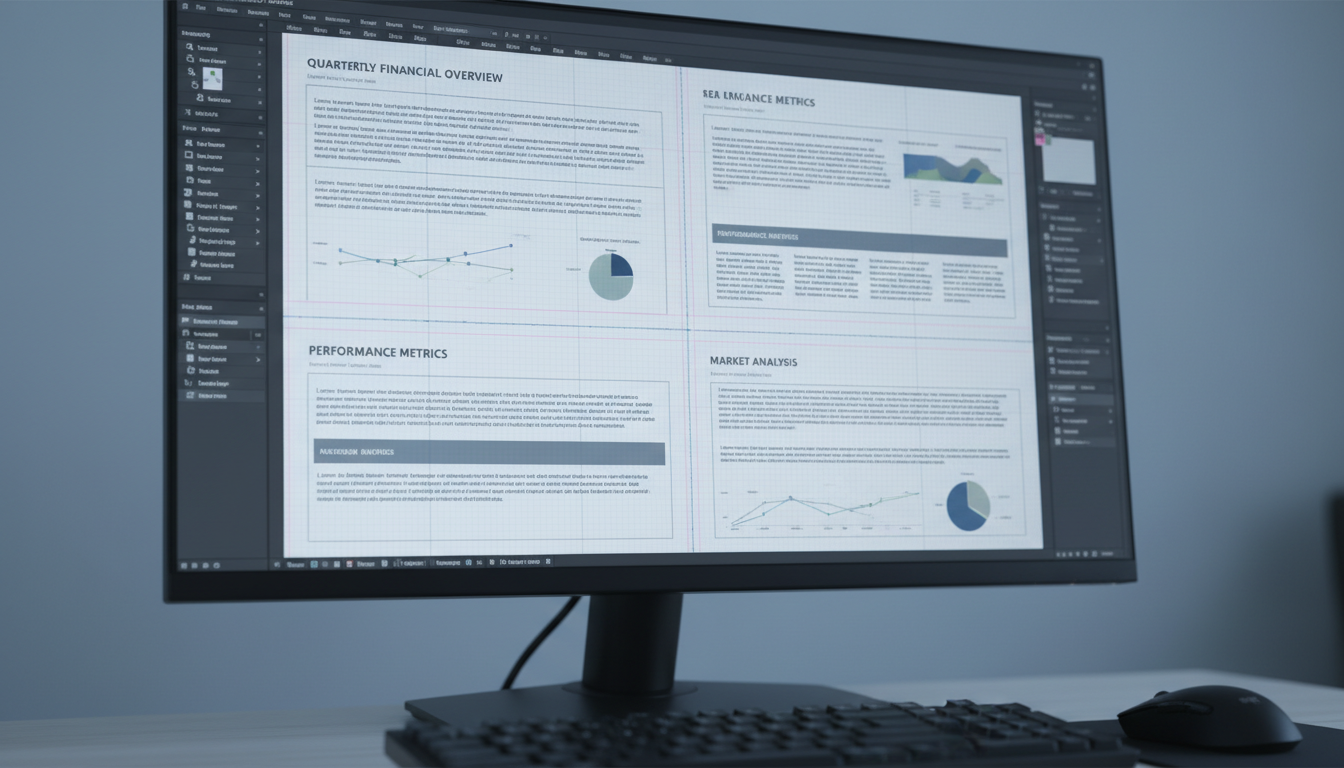
Under IFRS 18, the requirement to reconcile each MPM to its most directly comparable IFRS-defined subtotal moves these metrics from the periphery of the report into a structured, audited table. For a multilingual issuer, this means managing four identical table structures where every row label and numeric entry must be perfectly synchronized across German, English, French, and Spanish. Maintaining IFRS 18 Management-Defined Performance Measures multilingual consistency in these tables is a technical challenge because the linguistic length of financial terms varies significantly. A term that fits on one line in English may require three lines in German, potentially disrupting the vertical alignment of the reconciliation across different language versions.
Traditional workflows often fail here because they separate translation from expert desktop publishing. When a graphic designer adjusts a row label to fit a narrow column in an Adobe InDesign file, they may inadvertently simplify or truncate a term, breaking the link between the table and the narrative notes. ExportBridge eliminates this risk by providing a Single Point of Accountability. One expert manages the entire process, from the high-precision financial translations to the technical layout within the InDesign files. This ensures that the technical terminology and the numeric data remain perfectly aligned without the need for manual post-editing.
This unified workflow removes the inefficient back and forth between external translators and internal design teams, which is where the majority of reconciliation errors occur. By delivering publication-ready IDML or INDD files, we ensure that the management’s unique naming conventions are preserved in the exact layout where the auditor will review them. This level of control is essential for meeting the rigorous disclosure standards of IFRS 18 while ensuring a professional, harmonized presentation for global investors.
Harmonizing glossaries for IFRS 18 compliance in DE, EN, FR, and ES

Effective terminology management for IFRS 18 begins long before the first draft of the annual report is finalized. To maintain IFRS 18 Management-Defined Performance Measures multilingual consistency, we develop harmonized glossaries that serve as the technical foundation for all German, English, French, and Spanish disclosures. These glossaries are not merely lists of words; they are strategic maps that align rigid IFRS standards and banking terminology with the specific, idiosyncratic voice of a company’s management team.
Our approach leverages the deep institutional knowledge of GBS e.K., which has specialized in international reporting and multilingual corporate publishing since 2001. We ensure that every MPM, whether it is a specific adjustment to EBITDA or a custom margin subtotal, is assigned a fixed equivalent in each target language. This prevents the semantic drift that occurs when different translators interpret a management concept through their own subjective lens. By establishing these linguistic anchors early, we protect the integrity of the financial narrative across borders.
By integrating these glossaries directly into our integrated translation and InDesign production workflow, we eliminate the risk of manual error during the layout phase. When an expert desktop publishing specialist handles the file, they are working from a pre-approved linguistic master, ensuring that the terminology in the audited notes exactly mirrors the labels in the reconciliation tables. This rigorous high-precision financial translations process guarantees that the corporate tone remains authoritative and consistent across all language versions, satisfying both regulatory auditors and the global investment community.
Preparing for 2027: How to audit your multilingual IR reporting process
Transitioning to the IFRS 18 framework requires immediate action to prevent reporting bottlenecks in 2027. Investor Relations teams should begin by auditing all current non-GAAP measures to determine which will qualify as formal MPMs. This identification process is critical; any subtotal of income or expenses used in public communications outside of the financial statements must now be reconciled within a single, audited note.
Once these measures are identified, the priority shifts to establishing a multilingual master glossary. Achieving IFRS 18 Management-Defined Performance Measures multilingual consistency depends on locking down specific terminology in German, English, French, and Spanish well in advance of the first reporting cycle. This glossary acts as the single source of truth for both narrative disclosures and numeric tables, ensuring that management’s strategic voice is not diluted during the translation process.
Finally, companies should move away from fragmented workflows where translation and layout are handled by separate entities. To ensure full compliance, implement integrated translation and InDesign production. This approach allows for high-precision financial translations to be embedded directly into the source layout. By utilizing expert desktop publishing that handles both language and design, corporate issuers can deliver publication-ready files that meet the surgical precision required by IFRS 18, eliminating the risk of last-minute reconciliation errors or terminology drift.
Ensuring consistency across multilingual reports under IFRS 18 is no longer just a best practice; it is a regulatory necessity. Failing to align your management defined performance measures can lead to significant reporting risks and investor confusion. If you want expert help navigating these complex disclosure requirements and ensuring your financial communication remains precise in every language, our team is ready to support you. Explore our specialized reporting services to secure your international strategy today.