

Maintaining multilingual financial communication terminology consistency is achieved by combining specialized linguistic expertise with standardized glossaries and early project planning. This disciplined approach ensures that annual reports and financial statements remain accurate across all languages, which strengthens investor confidence and fulfills global regulatory requirements.
Discrepancies in cross border financial reporting often stem from more than just simple translation errors. A single term translated inconsistently between an English annual report and its German or French counterparts can trigger significant investor skepticism or even regulatory inquiries. For global organizations, maintaining linguistic precision is a strategic necessity that safeguards brand equity and ensures compliance with IFRS standards. Inconsistencies during the desktop publishing phase or within complex financial statements can dilute your message and misrepresent your fiscal health. This article examines the critical importance of harmonized glossaries in protecting investor trust. You will learn how to navigate specific multilingual terminology challenges, eliminate terminology drift in the final production stages, and implement a robust framework for global reporting that remains accurate across every language and jurisdiction.
The Strategic Value of Multilingual Financial Communication Terminology Consistency
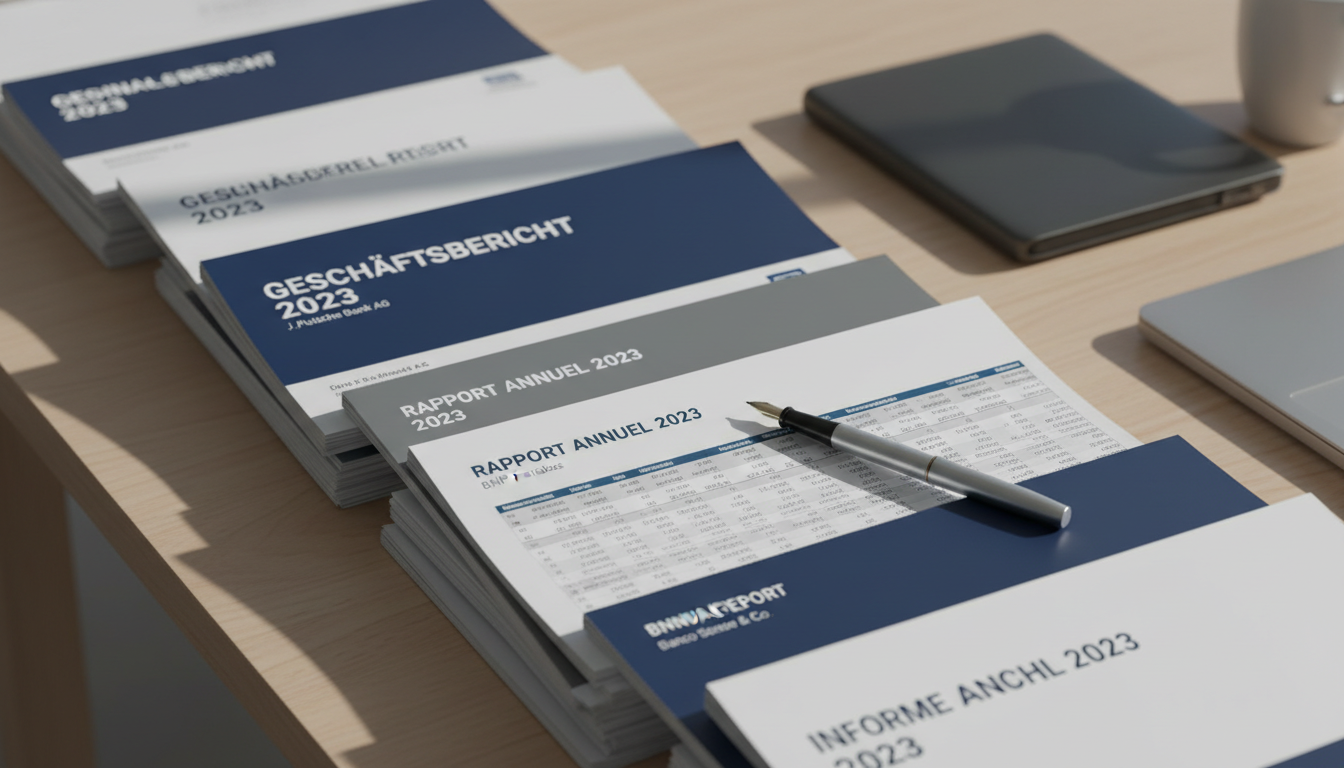
Multilingual financial communication terminology consistency represents the cornerstone of international corporate governance. It transcends the basic selection of linguistically correct words; it is the systematic practice of ensuring that every technical term carries identical legal weight and financial meaning across different jurisdictions. For companies operating in multiple markets, language is not merely a translation task but a critical compliance and trust asset.
In the context of global capital markets, high-precision financial reporting differs fundamentally from generic translation. While standard translation might prioritize stylistic flow or general meaning, financial reporting requires rigid adherence to IFRS standards and specific banking nomenclature. When a corporate issuer publishes reports in German, English, French, and Spanish, the terminology used for line items must remain perfectly harmonized. An investor reading a Spanish estado de situación financiera must derive exactly the same meaning and risk profile as a reader examining the German Bilanz or the English statement of financial position.
Maintaining this level of precision requires a shift from viewing translation as an outsourced service to treating it as a strategic function. By utilizing high-precision financial translation services, institutions ensure that their corporate voice remains steady, regardless of the linguistic environment. Inconsistent wording between language versions does not just create confusion; it introduces perceived regulatory risk and suggests a lack of internal control. True consistency ensures that nuanced disclosures regarding complex items, such as deferred tax assets or defined benefit obligations, are rendered with total semantic equivalence across all four key languages, thereby meeting the strict transparency requirements of modern financial markets.
How Harmonized Glossaries Protect Investor Trust Across Borders

Investors analyze financial reports to find stability and reliability. When a corporate issuer presents data across different markets, any linguistic deviation can be interpreted as a lack of rigor. How do harmonised glossaries protect investor trust? They function as a single source of truth that prevents cognitive dissonance among stakeholders, ensuring that the company appears as a unified entity regardless of the language the reader speaks.
Maintaining multilingual financial communication terminology consistency is not just a stylistic choice; it is a mechanism for mitigating perceived risk. If a German annual report uses three different terms to describe operating profit while the English version remains consistent, it creates an immediate red flag for institutional investors. This inconsistency suggests that the company may lack standardized internal reporting controls or that the translation was handled without proper oversight. By maintaining a unified glossary, an expert multilingual reporting team ensures that technical terms like impairment, provisions, or contingent liabilities carry the exact same accounting weight and legal nuance in Madrid as they do in Frankfurt or London.
This harmonization is particularly critical when navigating IFRS disclosures. A harmonized glossary acts as a safeguard, ensuring that the corporate voice remains identical across all four key languages: German, English, French, and Spanish. When an investor sees that a specific contingent liability is described with the exact same terminology in the French rapport annuel as in the Spanish informe anual, it reinforces the perception of a transparent, well-managed organization.
Without this central linguistic authority, terminology begins to drift. Different translators might choose synonyms that, while technically correct in a general sense, do not match the specific IFRS definition adopted by the company. A structured glossary eliminates this variability, protecting the firm's reputation for precision. This level of control is why many institutions now prioritize high-precision financial translation services that integrate terminology management directly into the production workflow.
Risks of Inconsistent Financial Terminology in Annual Reports
Inconsistent terminology in an annual report is more than a linguistic oversight; it is a significant financial liability. When technical terms fluctuate between the management report and the consolidated financial statements, it triggers immediate regulatory scrutiny. Regulators and auditors view linguistic drift as a symptom of weak internal controls. If a company cannot maintain a uniform definition for "cash-generating units" or "fair value hierarchies" across its German, English, French, and Spanish editions, the integrity of the entire disclosure is called into question.
This fragmentation often stems from the traditional agency model. To meet demanding deadlines, large agencies frequently split a single report among a dozen freelancers. This creates a "telephone game" effect where the nuanced corporate voice is lost as different translators choose varying synonyms for the same IFRS line items. These discrepancies necessitate extensive, last-minute reconciliation cycles, often leading to delayed filings and increased coordination costs.
At exportbridge.biz, we eliminate these risks by utilizing a single-expert model. Unlike fragmented agency workflows, one dedicated professional manages the entire process from translation to layout. This single point of accountability ensures that multilingual financial communication terminology consistency is maintained across every page. By consolidating language expertise and technical production, our expert multilingual reporting team prevents the terminology drift that typically occurs during multi-person handoffs, delivering a unified, publication-ready document that reinforces investor confidence.
Navigating IFRS Terminology Across German, English, French, and Spanish
Navigating the linguistic requirements of IFRS requires more than just access to the official EU translation handbooks. While the International Accounting Standards Board provides a foundation, an expert multilingual reporting team must reconcile these standards with local banking cultures and specific regulatory preferences. For example, the English term "Fair Value" is officially "Beizulegender Zeitwert" in German, yet the surrounding narrative in a management report must reflect the stylistic expectations of German financial analysts to maintain credibility.
Maintaining multilingual financial communication terminology consistency becomes complex when handling concepts like "Expected Credit Losses" (ECL). In French, this is "pertes de crédit attendues," while in Spanish, it is "pérdidas crediticias esperadas." The challenge lies in ensuring that the specific disclosure wording regarding the calculation models and risk parameters remains identical in meaning across all versions. A minor variation in how a "valuation allowance" or "contingent liability" is described can lead to differing interpretations of a company's risk profile.
Furthermore, this precision must extend beyond the annual report. Terminology used in a French communiqué de presse or a German Zwischenbericht must mirror the audited Spanish cuentas anuales. At exportbridge.biz, our proven track record since 2001 ensures that this linguistic thread remains unbroken across the entire investor relations suite. By aligning every quarterly statement and press release with the core IFRS glossary, we provide high-precision financial translation services necessary to meet the scrutiny of global capital markets.
Eliminating the Terminology Drift in the Desktop Publishing Phase

The most vulnerable moment for multilingual financial communication terminology consistency occurs during the technical handoff from the translator to the graphic designer. In a traditional workflow, a linguist delivers a Word document, which is then manually copy-pasted into Adobe InDesign by a design professional who may not speak the target language. This gap frequently introduces errors that compromise the integrity of the financial data. For example, a designer unaware of German hyphenation rules might split a complex term like Eigenkapitalveränderungsrechnung incorrectly, or worse, separate a negative sign from its corresponding numerical value at a line break, leading to potential misinterpretation of the financial results.
Working directly within the Adobe InDesign environment (IDML/INDD) eliminates this risk. By maintaining a unified workflow where one expert handles both the linguistic nuance and the desktop publishing, the intended meaning of every IFRS disclosure remains intact. This integrated approach ensures that specific formatting requirements, such as the alignment of decimal points in Spanish tables or the preservation of compound terms in French, are managed by someone who understands the underlying accounting concepts.
Our expert multilingual reporting team provides a level of control that fragmented agency models cannot match. Instead of receiving a translated text that requires hours of internal layout adjustment and proofreading, corporate issuers receive publication-ready files. This eliminates the need for post-editing and ensures that the final printed or digital report is a perfect mirror of the source document. By utilizing these high-precision financial translation services, institutions remove the final hurdle of terminology drift, guaranteeing that their corporate voice remains precise from the initial draft to the final press run.
Best Practices for Implementing a Multilingual Communication Strategy
Establishing a robust strategy for global reporting requires moving beyond reactive translation cycles. The first step involves developing a comprehensive multilingual glossary before the reporting season commences. This document should go beyond official IFRS definitions to include specific corporate preferences for German, English, French, and Spanish. By securing agreement on these terms early, you prevent the friction of late stage revisions that often compromise multilingual financial communication terminology consistency.
Efficiency is further enhanced by adopting a single point of accountability for both language and layout. Managing these two functions as a unified workflow eliminates the coordination overhead that typically occurs between external translators and internal design departments. This integrated approach, championed by our expert multilingual reporting team, ensures that the technical precision of the financial data remains intact during the InDesign production phase.
Finally, align your internal accounting and investor relations teams on preferred phrasing well before the fiscal year ends. This proactive coordination avoids the fragmentation that occurs during the final filing rush. Organizations looking to achieve this level of rigor can draw on the legacy of GBS e.K. in Catalonia, where we have refined these precision workflows since 2001. For institutions seeking to upgrade their reporting infrastructure, contact us for a consultation to implement these high-precision financial translation services within your organization.
Maintaining consistency in financial terminology is crucial for global transparency and compliance. When your reporting remains precise across multiple languages, you build trust with stakeholders and minimize the risk of costly errors. While managing these details internally is possible, the complexity of international standards often benefits from a dedicated approach. If you want expert help to ensure your multilingual communication is flawless, we invite you to view our Services for tailored solutions. Let us help you communicate your financial performance with absolute clarity.